
Legal Innovation

July 22, 2026
 By Sara Molina
TWITTER @SaraMolinaPT
We've been talking for months about models, agents, co-pilots, and which is the best artificial intelligence platform. But I have the feeling that we're paying too much attention to the technology and too little to a much deeper change.
For the first time, we're not just buying software. We're buying reasoning ability.
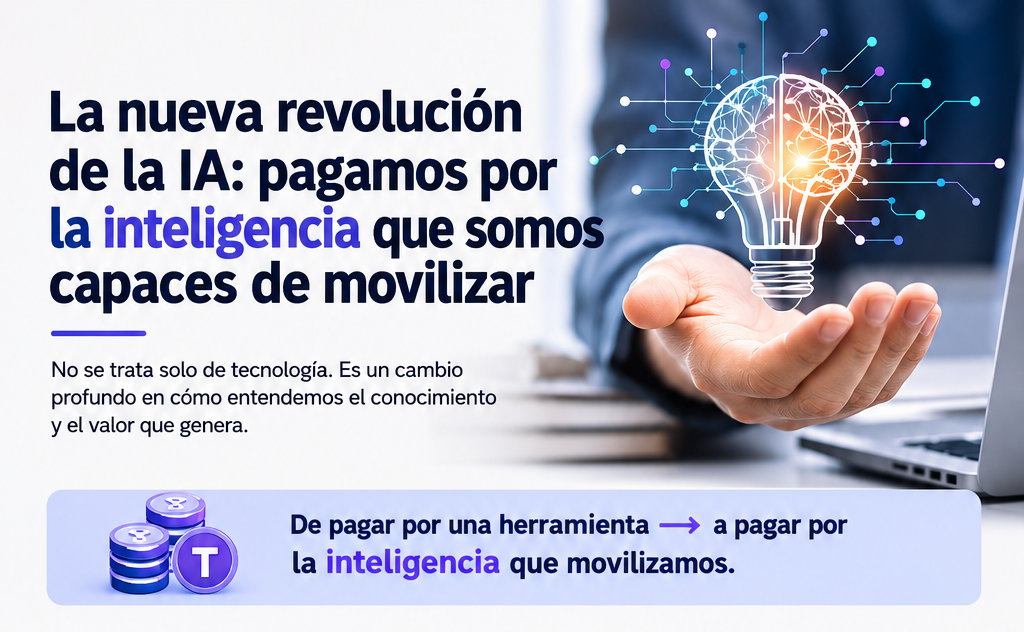
Behind concepts like tokens, Pro or Enterprise subscriptions, and new pay-per-use models, there's more than just a new way to bill. There's a paradigm shift in how we understand knowledge and the value it generates.
Until now we paid for access to a tool. Today we are starting to pay for the intelligence we are able to mobilize.
And that changes a lot of things.
Tokens are much more than a billing unit. They are, in fact, a measure of the knowledge we mobilize, the context we provide, and the complexity of the work we ask of a model. Every document we incorporate, every knowledge base we connect, every long conversation, or every specialized agent consumes cognitive capacity. And that capacity, for the first time, has a tangible cost.
However, the real change is not in how much the tokens cost, but in what they force us to learn.
Knowledge is no longer free.
 For years we've assumed that storing more information, generating more documentation, or connecting more systems had little economic impact. With AI, this changes.
Organizations will need to start managing their cognitive capital the same way they manage time, budget, or talent today. It won't be about consuming more artificial intelligence, but about using it where it truly adds value.
Not all tasks require the same level of intelligence
Just as not all matters require the most senior partner in a firm, not all tasks require the most advanced AI model.
Lightweight, fast, and efficient models for repetitive tasks will coexist with much more powerful ones for complex analysis, strategy, or legal reasoning. Choosing the right model will no longer be a technological decision but a business one.
Maturity will be the true return on investment
Many organizations still believe that savings will come simply from purchasing Pro or Enterprise licenses. I think that view is incomplete. The real return on investment won't depend on the license itself, but rather on people's ability to work intelligently with AI: formulating better instructions, providing the necessary context, designing efficient workflows, reusing knowledge, and properly validating responses.
Two professionals using the same platform can achieve radically different results. The difference lies not in the tool itself, but in the maturity with which they use it.
From measuring hours to measuring intelligence consumed
For decades we have managed work in terms of time.
I wouldn't be surprised if in a few years we also started talking about consumed intelligence.
Cost per process.
Cost per agent.
Cost per million tokens.
Not because tokens are the goal, but because they will allow us to understand how much knowledge we mobilize to make a decision or provide a service. The financial conversation will also evolve.
The true competitive advantage
I am increasingly convinced that the difference between organizations will not be determined by who has access to the best AI. It will be determined by who knows how to use it most effectively.
Someone who understands when to use an advanced model and when to use a more efficient one.
Whoever is capable of building a quality context.
Whoever designs truly useful agents.
Whoever manages to transform knowledge into better decisions.
Because artificial intelligence, by itself, does not generate a competitive advantage. What does is the ability to integrate it thoughtfully into the way we work.
A new way of managing knowledge
Perhaps in a few years we will even stop talking about AI licenses.
We will begin to talk about intelligence budgets, model portfolios, token consumption optimization, and knowledge governance.
And that will likely be the real challenge for organizations. Not adopting more artificial intelligence, but developing the maturity to convert every token consumed into knowledge, every piece of knowledge into a better decision, and every decision into real value for the business.
Because, in the end, the most valuable asset won't be the most powerful model. It will be the judgment of the people who know how to work with it.
The next AI revolution will not come from smarter models, but from more mature organizations that can manage intelligence as a strategic resource.
Legal Innovation
Technology advances exponentially. Clients change with her and so do their needs and what they expect from their attorneys. In this blog we will talk about innovation, creativity and the most advanced technologies for the legal sector. #legaltech #innovation #change